
Red and White Threads
Rituals of Spring, Memory, and the Invisible Education of Tradition

The world is unhinged. Entitled nations bomb others and create chaos. Many applaud like seals. Others don’t give a damn and plan their next holiday. Life, in all its splendour, unfolds before our eyes.
I woke up early, and the first thing I saw on my WhatsApp was a message from a dear Romanian friend. Then another message from another dear Romanian friend. I haven’t seen them in such a long time it hurts. Everything seems so long ago — as if from a different life, on a different planet.
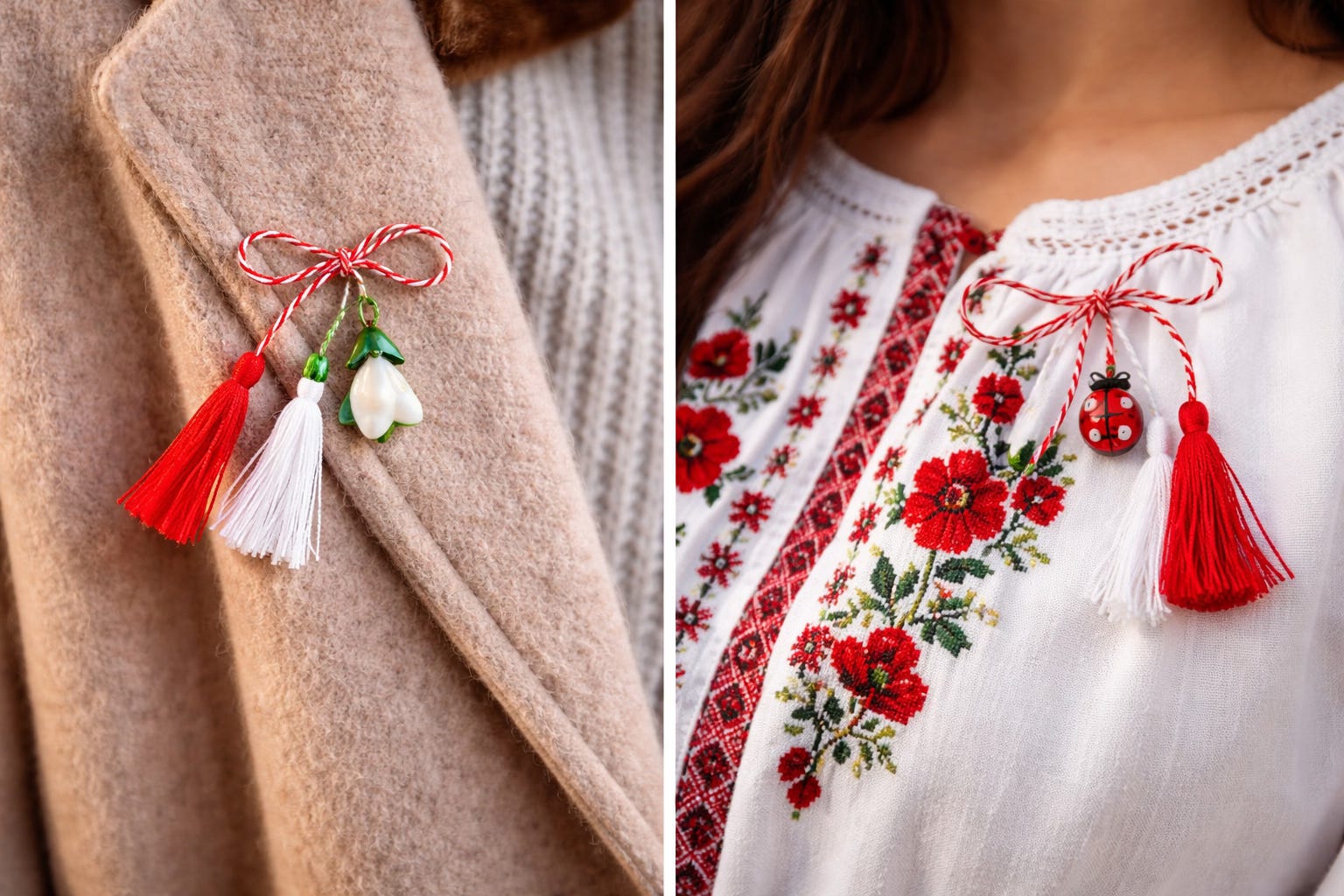
I received messages and images. Evocative images for every soul born in Romania. On such a day, women and girls receive small tokens symbolising the beginning of spring and beautifully written wishes. You will see a selection of images in the gallery below.
When one is far away, one receives such images like the ones here.


Now, I as I am writing these words I felt the need to listen to Georgian music. You might want to listen to it as well. The harmonies are out of this world. I fell in love with this music when I had the privilege of visiting Tbilisi many moons ago, invited by members of a Georgian group visiting Romania. I was their guide, and the bond created over their ten-day visit was strong, genuine, authentic. But that is another story for another time.
Back to this special day. In Romania, weeks before March 1st, the main streets of towns — and very much the villages too — become busy, filled with colour. Small tables appear in high-footfall areas, and artisans display their creations. In the past, it was mostly handmade. I am sure that nowadays the market is flooded with plastic-infused gifts, but surely some artisans still keep the tradition alive and sell authentic pieces.
The tradition is that men offer such gifts to girls and women. It is a token of appreciation — a way of saying “I like you” when we speak about the younger generation, a way of saying “I appreciate you” when offered to friends, a way of celebrating women and aligning with the spring season, when everything comes back to life.
At the time — and hopefully still today — mothers would prepare little bags full of mărțișor for boys to take to school and gift to their teachers and classmates. Some boys brought one for every girl; some did not. I have to say it could be quite embarrassing to see your classmates wearing a carpet of mărțișoare on their school dresses while you had only a few. But it never lasted long, and one was still very happy to be part of the celebration.
I remember us girls bringing mărțișor and gifting them to each other. The nicest ones I would keep and gift again the following year. We were — without even knowing the term — rather eco-friendly.
Tiny bunches of snowdrops and other spring flowers were gifted as well. I remember going home with a handful of such bouquets. The streets were full of colour after the grey days of winter, buses filled with fresh scents, more smiles on people’s faces.
In offices, men continued the tradition, and women received these spring tokens. Nothing sexual, nothing to overinterpret — well, sometimes perhaps it was a gentle way of opening a heart-to-heart dialogue — but mostly it was simply the continuation of a very old Romanian tradition.
DIFFERENT COUNTRY - LACK OF TRADITIONS
When I think about the male-dominated environments I worked in over the last few years, I cringe. I sometimes wonder whether the absence of such traditions has had an impact on the way some men behave toward women here — the ease with which they slip into bullying behaviour or workplace abuse.
Traditions, in their own way, can keep people on a steadier path. They remind us of respect, of ritualised appreciation, of boundaries. But perhaps I am simply too much of a romantic — a lover of tradition.

THE TRADITION OF MARTISOR - A STORY
Long ago, when winter did not wish to leave the earth, the Sun descended in the form of a beautiful young woman to dance in a village. Winter, jealous and cruel, kidnapped her and locked her away in a dark fortress.
The world fell into silence. Rivers froze harder. Birds stopped singing. Without the Sun, hope thinned.
A brave young man decided to rescue her. He searched for three seasons — through snowstorms, across icy forests, over frozen mountains. When he finally found the fortress, he fought Winter with all his strength. The battle lasted days. He freed the Sun, but he was gravely wounded.
As the Sun rose again into the sky, warmth returned to the earth. Snow began to melt. From the places where the young man’s blood fell onto the white snow, the first snowdrops appeared — delicate white petals marked by red.
People began twisting two threads together — one red like blood, one white like snow — to remember the courage that brings back light, and the fragile beauty that follows sacrifice.
And so, each year, at the beginning of March, the red and white thread is worn to celebrate the victory of spring over winter, of life over hardship, of hope over despair.


I remember that in some parts of the country, people tie these delicate ribbons onto trees, inviting good crops and offering blessings to the trees as well.
Previous generations embraced and cherished rituals. Rituals made sense; they were part of the cycles of life. They taught us more than we could even name. It was education at a subliminal level. And it worked.
Nowadays, there is a tendency to enter other countries with dirty boots — to ridicule, erase, or extinguish traditions. How? By introducing many Trojan horses. Greek mythology teaches us so much.
Until next time, be well.
Happy Spring Day!
Corina Stupu Thomas is a writer, artist, trauma-informed practitioner, and former international project and events manager. Her work sits at the intersection of creativity, healing, and cultural critique, where writing, visual art, and reflective practices are used to support recovery from abuse, displacement, and systemic harm, and to accompany others in building resilience and reclaiming authenticity.
She explores creativity as both refuge and resistance—particularly for those who have been silenced, marginalised, or slowly trained to doubt their own voice.
Connect with me on Linkedin
Explore my therapy work, writing and creative work on Linktree

Thank you for sharing the meaning and your personal history of this tradition. The story made me think of people coming out of an ice age and experiencing spring for the first time in generations.
I am so thrilled to read your words and I love the vision you have. This tradition goes back in time a long long time ago and you might be right! Big hug!